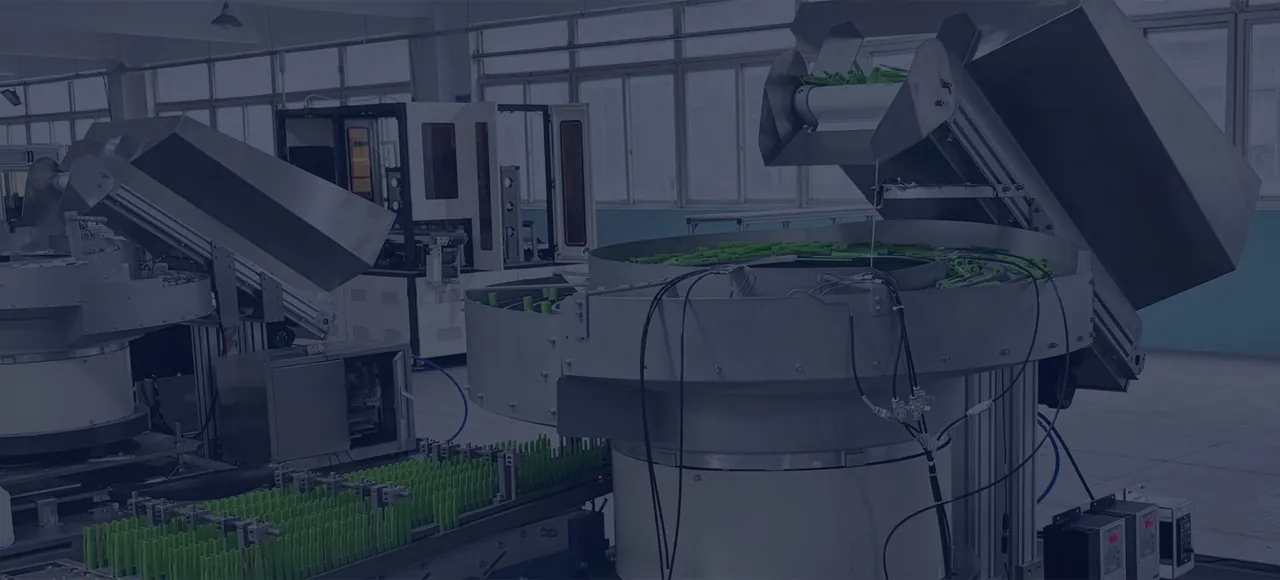
How does a step feeder work?
Moving plates lift parts from a low-level hopper one step at a time. The controlled elevation reduces the mass of components moving together and transfers parts towards a linear orientation track. Incorrectly presented parts can return to the hopper while accepted parts continue to the discharge.
The step mechanism performs bulk elevation and initial separation. Final orientation may still use tailored rails, profile tooling, sensors or machine vision, followed by a buffer and component escapement.
When should a step feeder be considered?
- Larger or heavier parts that are awkward in a conventional bowl
- Components where lower operating noise is an important project constraint
- Parts that benefit from reduced recirculation and lower part-on-part movement
- Cells needing low operator loading height and a linear discharge route
- Applications where the part has a stable pose that can be developed along a track
Step feeder or vibratory bowl feeder?
| Decision | Step feeder | Vibratory bowl feeder |
|---|---|---|
| Bulk movement | Incremental lifting from a hopper | Continuous movement around a spiral track |
| Loading height | Often low and operator-friendly | Depends on bowl and bulk hopper arrangement |
| Orientation path | Developed across steps and linear tooling | Developed around bowl track tooling |
| Best decision basis | Representative parts, required orientation, accepted rate, noise, footprint and downstream interface | |
What must be proven?
Trials should confirm that parts do not bridge in the hopper, trap between moving steps or fall back in a damaging way. The linear track must remain stable through demand changes, and the final output should be measured as accepted parts at the receiving datum.
System integration
A complete project may include bulk level sensing, variable speed control, a full-track sensor, accumulation, guarding, access for clearing, the final release device and machine-ready signals. Those interfaces should be defined before the mechanical envelope is frozen.