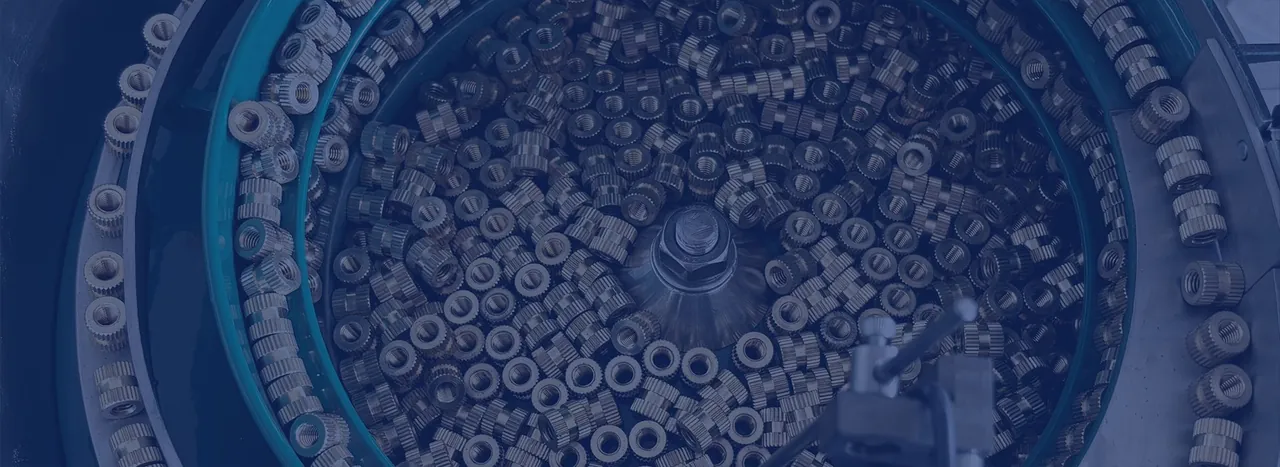
What does a vibratory bowl feeder do?
A bowl feeder converts randomly loaded components into a controlled feed. Vibration moves parts from the bowl centre onto a rising track. As each part travels, mechanical gates, profile rails, air assistance, sensors or a final vision check can remove unsuitable attitudes and allow the accepted orientation to continue.
The useful result is not movement inside the bowl. It is a sustainable supply of correctly oriented parts at the agreed outlet, with the correct spacing and enough buffer for the downstream machine.
When is bowl feeding a strong route?
Vibratory bowl feeders are often considered for dedicated or closely related parts whose geometry offers stable orientation features. Typical applications include fasteners, clips, connectors, inserts, mouldings, caps, closures and small metal or plastic production components.
- Repeatable, high-volume production with a defined component family
- Components that can tolerate controlled vibration and recirculation
- A clear exit attitude that can be achieved through track tooling
- Assembly or packing machinery that needs a steady oriented queue
What is included in a complete bowl feeder system?
The bowl and drive are only one part of the feed path. A production system may also include a bulk hopper or elevator, level sensing, a controller, acoustic treatment, guarding, a linear track, back-pressure sensing, a component escapement and an electrical handshake with the receiving machine.
| Specification area | Question to answer | Why it matters |
|---|---|---|
| Component evidence | Are samples representative of every mould, supplier and normal tolerance? | Tooling must work with production variation, not an ideal sample. |
| Required orientation | Which face, axis and rotational position must reach the outlet? | The track needs a measurable acceptance condition. |
| Output | How many accepted parts per minute are needed at the discharge? | Rejects and recirculation must not hide the real available rate. |
| Machine interface | What height, buffer, release device and signals are required? | A good bowl can still fail if the hand-off is unstable. |
When should another feeder be assessed?
Parts that tangle, mark easily, vary widely or lack stable mechanical orientation features may justify a step feeder, a vision-guided robotic feeder or a hybrid route. Selection should follow a sample review rather than a generic speed claim.
How should performance be accepted?
Agree the component variants, loading condition, outlet datum, sustained test duration, accepted output, allowable interventions and recovery events before manufacture. The test should include replenishment, full-track demand changes and controlled restart after a stop.