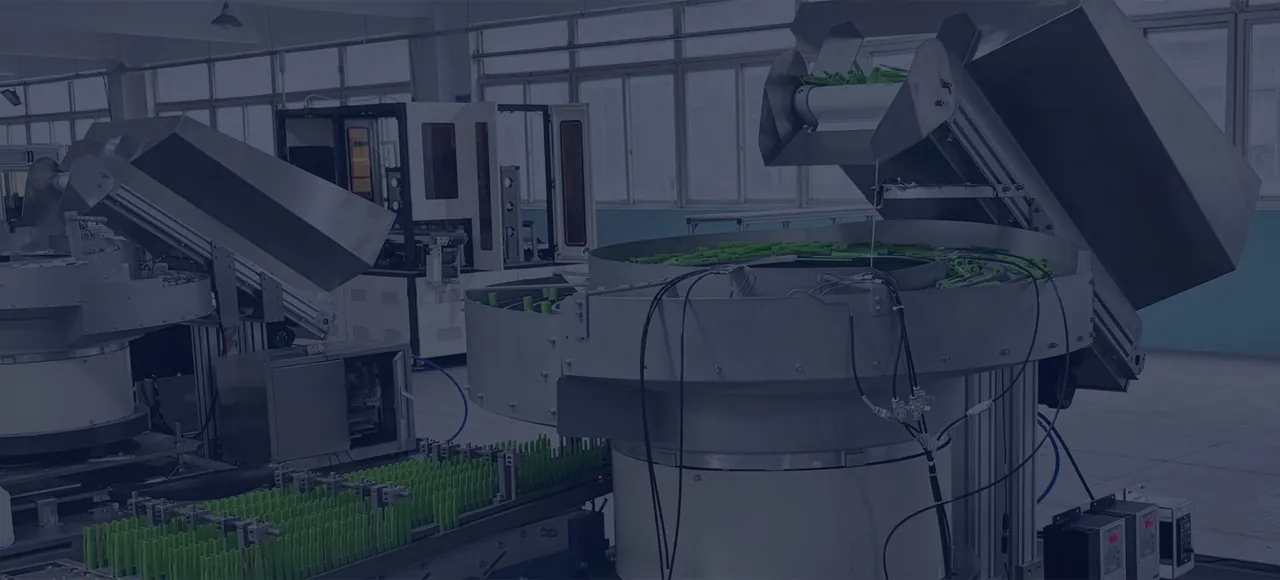
The discharge condition is the real specification.
A feeder can orient parts correctly and still fail in production if the final hand-off is unstable. The last section of track, the queue behind the escapement, the part-present sensor and the receiving machine cycle determine whether every component arrives consistently.
Presentation methods.
Linear tracks and buffers
A straight vibratory or driven track transfers oriented parts and provides controlled accumulation. Track geometry, coatings, covers and sensor positions are developed around part stability and acceptable back-pressure.
Escapements and one-part release
An escapement separates the leading part from the queue and releases it on command. Pneumatic, servo or mechanical devices may be used depending on cycle time, force, accuracy and environment.
Nests and datum stations
A nest can establish the final location and support a robot pick, press operation, assembly step or secondary inspection. The nest may include clamps, part-present confirmation or poka-yoke features.
Tubes, chutes and blow feeding
Suitable components can be transferred through gravity chutes or delivery tubes. Air-assisted transfer requires assessment of part stability, impact, noise, contamination and the receiving stop.
Define “ready” as a physical position plus a control state: part located, sensor confirmed and the receiving machine permitted to cycle.
Buffering and line balance.
The feeder should not hunt with every machine cycle. A correctly sized buffer absorbs short interruptions and lets the orientation device run in a stable range. Low-level and high-level sensing control replenishment, feeder output and fault timing.
Control handshakes.
- Ready-for-part and request-part signals
- Part-present and part-taken confirmation
- Buffer low, full and jam states
- Feeder enable, reset and permissive signals
- Reject confirmation and reject-bin status
- Safe stop, guarded access and restart sequence
Robot-ready presentation.
A robot may pick from a fixed nest, a moving conveyor, a flexible feeder plate or a controlled array. The gripper approach, access, datum repeatability, pick confirmation and failed-pick recovery should be considered with the presentation method.